
Stirva Team
Dec 24, 2025
How to Calculate Ingredient Costs for Baked Products
You’ve spent years perfecting your signature sponge or that flaky pastry crust. You know exactly how long to cream your butter and at what temperature your oven yields the perfect rise. But here is a hard truth: You can be a world-class baker and still go out of business if your ingredient costing is flawed.
In our Recipe Costing for Home Bakers: The Complete Beginner-to-Pro Guide, we looked at the big picture. But today, we’re zooming in on Ingredient Costing
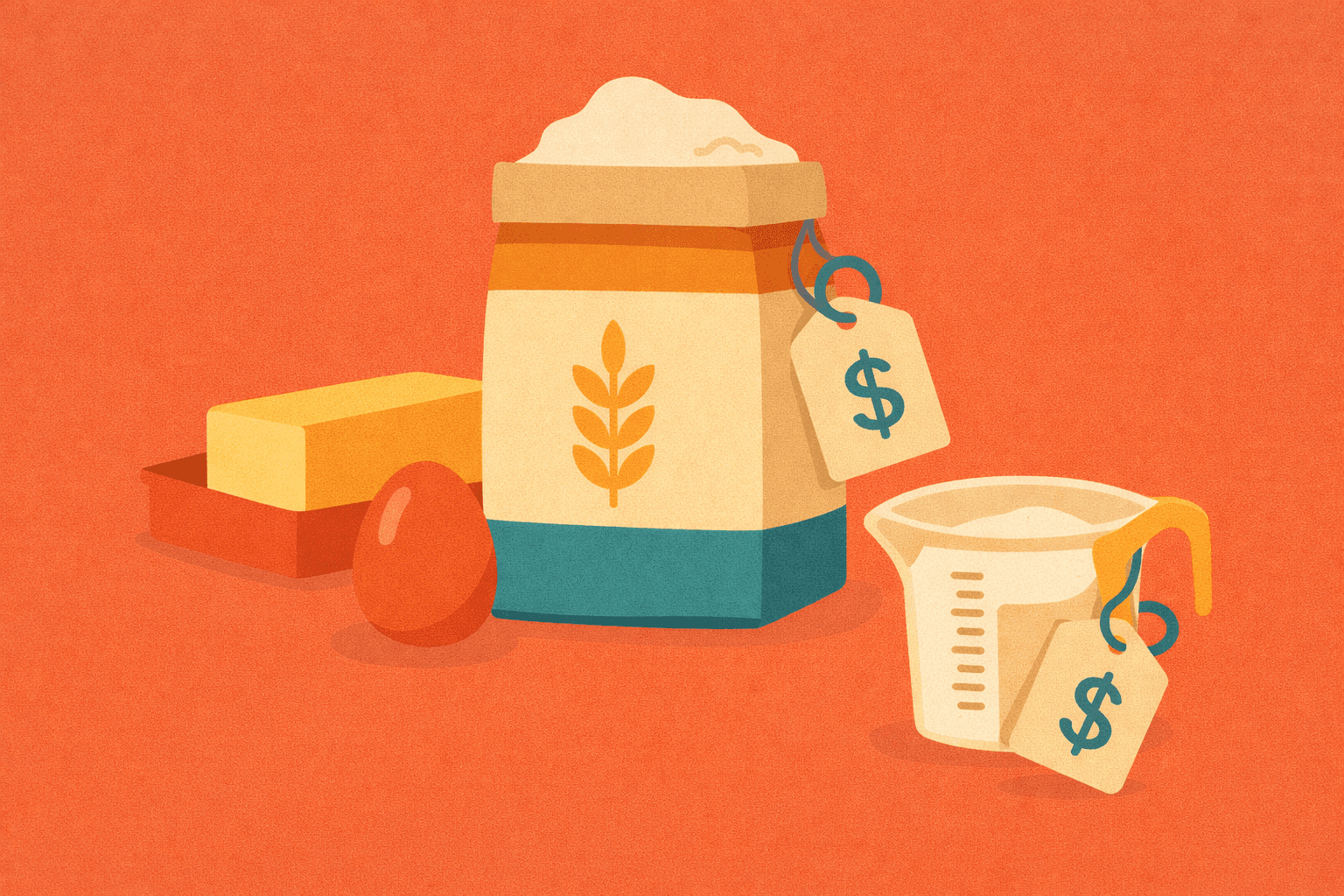
Ingredient costing for baking is the most overlooked - and most important - part of recipe costing. If your ingredient numbers are wrong, every recipe cost and price that follows will be wrong too, no matter how good your formulas are.
This guide focuses on one thing only: how to calculate accurate ingredient costs so they can be used reliably across all your recipes. We won’t cost a full recipe here. We’re building the data layer that everything else depends on.
Section 1: The “Base Unit” Revolution
The biggest mistake home bakers make is costing ingredients “per packet.” While it’s easy to say “Flour is $12 a bag,” your recipes don’t use “bags” - they use grams.
To build a professional system, you must convert every single purchase into a Base Unit. In the baking world, there are only two languages that matter for costing: Mass (Weight) and Volume (Liquid). The objective is to change to one standard unit, either gram for mass based units or milliliter for volume based unit.
The Rule of Mass (Grams/Kilograms/Pounds)
For solids like flour, sugar, butter, and chocolate, weight is the gold standard.
Standardizing to Gram (g):
Most suppliers sell in Kilograms (kg). Since most recipes use Grams (g), you must know that 1 kg = 1,000 g.
Formula: (Total Price ÷ Total Weight in kg) ÷ 1,000 = Price per Gram
Example: A 25 kg bag of flour costs $45.
$45 ÷ 25 = $1.80 per kg.
$1.80 ÷ 1,000 = $0.0018 per gram.
The Math of Conversion (Imperial):
The rule of thumb for all other purchase packet size to convert to g is as follows:
Formula: (Total Price of Ingredient ÷ Total Weight of Ingredient) ÷ Conversion rate from Purchase weight to g = Price per Gram
See table below which has the list of all other weights and their conversion to g.
The Rule of Volume (Milliliters/Liters/Gallons)
Liquids follow a similar logic, but they use volume units. In baking, consistency across your costing system is vital.
Standardizing to Milliliters (ml):
Most professional bakers standardize to “ml” because it allows for the highest precision.
1 Liter (L) = 1,000 ml
Example: A 2L bottle of high-quality vanilla extract costs $120.
$120 ÷ 2 = $60 per Liter.
$60 ÷ 1,000 = $0.06 per ml.
If your recipe calls for 15ml, you now know with total certainty that it costs you $0.90.
See table below which has the list of all other volumes and their conversion to ml.
Stirva Tip: Manually doing these conversions every time you shop is a recipe for burnout. Stirva handles these unit conversions automatically - you tell it what the bag cost, and it tells the recipe what the gram cost.
Section 2: The Puzzle of “Abstract Units” (Eggs, Sticks, and Pieces)
This is where the spreadsheets of most home bakers break. How do you cost something that you buy by the “dozen” or the “pack” but use by weight or count?
The Egg Equation
Eggs are the most common abstract unit. You buy 12, but you use 2. Or worse, you use 100g of egg whites.
Weighted average: Weigh 5 eggs without shells. A standard large egg nets about 50g of usable product.
Piece to mass: If a dozen eggs cost $6.00, each egg is $0.50.
The gram cost: $0.50 divided by 50g = $0.01 per gram.
For a much deeper dive into the specific math of these tricky conversions, including density (why a cup of butter weighs more than a cup of flour!), read our guide on How to Convert Recipe Units in Baking (Grams, Cups, Tsp, Tbsp).
The Stirva Way: This is why Stirva encourages costing by weight. It eliminates the “packing” variable and ensures that your cost per batch is identical every single time.
The Baker’s Master Conversion Tables
To cost recipes accurately, you need to be able to move between units seamlessly. Below are the definitive conversion tables for the most common units used in home and professional bakeries.
1. Mass (Weight) Conversions
Mass is the most accurate way to cost dry ingredients. Whether you are buying in bulk kilograms or smaller pounds, use this table to find your “cost per gram.”
To Convert From | To | Multiply By |
Kilograms (kg) | Grams (g) | 1,000 |
Grams (g) | Kilograms (kg) | 0.001 |
Pounds (lb) | Ounces (oz) | 16 |
Pounds (lb) | Grams (g) | 453.59 |
Ounces (oz) | Grams (g) | 28.35 |
Grams (g) | Ounces (oz) | 0.035 |
Example: If you bought 2.5 lb of specialty cocoa powder, you would calculate:
2.5 x 453.59 = 1,133.97g total. Divide your total price by 1,134 to find your cost per gram.
2. Volume (Liquid) Conversions
Volume is typically used for water, milk, oils, and extracts. While we recommend weighing liquids for ultimate precision, these conversions are the standard for liquid costing.
To Convert From | To | Multiply By |
Liters (L) | Milliliters (ml) | 1,000 |
Gallons (gal) | Liters (L) | 3.785 |
Quarts (qt) | Milliliters (ml) | 946.35 |
Pints (pt) | Milliliters (ml) | 473.18 |
Fluid Ounces (fl oz) | Milliliters (ml) | 29.57 |
Cups (standard) | Milliliters (ml) | 236.59 |
3. The “Small Unit” Reference (Volume to ml)
Small additions like salt, baking powder, and extracts are often measured in spoons. To cost these, convert them to milliliters first.
Unit | In Milliliters (ml) |
1 Tablespoon (tbsp) | 14.79 ml |
1 Teaspoon (tsp) | 4.93 ml |
1/2 Teaspoon | 2.46 ml |
1/4 Teaspoon | 1.23 ml |
How to allow for Wastage Baking
If you only cost what ends up in the oven, you are losing money. In a professional kitchen, wastage is accounted for as a cost of doing business.
1. Structural Waste (The Scrape and Trim)
This is the batter left in the bowl, the flour on the counter, and the tops of cakes you level off to make them flat.
The Fix: Add a 3% “Scrape Factor” to all dry and wet ingredients (Stirva Recommendation).
2. The “Oops” Factor (Failed Batches)
Every baker, no matter how skilled, has a batch that sinks, burns, or doesn’t meet quality standards. If you bake 100 cakes a year and 5 of them are failures, you have a 5% failure rate.
The Costing Strategy: You must bake this failure rate into your ingredient prices. If you don’t, you are personally paying for those 5 failed cakes.
3. Spoilage and Expiry
Fresh berries, heavy cream, and specialty garnishes have a short shelf life. If you buy a carton of cream for a specific order and the rest goes sour before the next one, the entire carton must be costed to that next order.
How Stirva Removes the Burden
By now, you might be thinking: “I just want to bake, not spend four hours on a calculator.” We agree. That’s why Stirva was built to handle the “Boring Math”:
Pantry Logic: Enter your ingredient once (e.g., 25kg Flour for $45).
Automatic Intelligence: Stirva does the conversions to grams and ml for you.
Real-time Updates: If the price of eggs jumps tomorrow, you enter it once in your Expense. Stirva automatically recalculates the cost of every recipe and product that uses eggs.
If you would like a live example of how to apply this to a cake, read How to Calculate Ingredients Costs for a Cake
Conclusion
Ingredient costing isn’t about being an accountant; it’s about being a professional. When you know your unit costs, account for your failed batches, and master your conversions, you gain a level of confidence that “vibes-based pricing” can never give you.
Start your free 30-day trial of Stirva.app and see how easy it is to automatically calculate your true recipe costs, track all your expenses, and set prices that actually lead to profit!
Read more blogs like this
More guides on costing, pricing, and running a profitable home bakery.

Best Home Bakery Software (2026): 6 Apps Compared Honestly

We compared Stirva, BakeProfit, Bakesy, Hotplate, BatterSuite and Cottage CMS on price, per-order fees and features, using a baker taking 20 orders a month.
Stirva Team
Oct 13, 2026

How to Scale a Recipe for Large Orders Without Ruining It
Multiplying every ingredient by the same factor is how scaled batches collapse. Here is what actually changes for leavening, salt, eggs, and pan size.
Stirva Team
Sep 15, 2026

How to Schedule Baking Orders: A Weekly System That Actually Holds
Stop rebuilding your week every Monday. A repeatable scheduling system for home bakers: how to find your real capacity, batch your days, and stop overcommitting.
Stirva Team
Aug 18, 2026